Sunday, July 26, 2015

Getting to B, to Bethsaida: Gathering Resources for Mission

In Mark 6:45-53, Mark recounts the episode of Jesus walking on the sea. The disciples have been sent to the other side of the sea, but they struggle through the night against an adverse wind. When Jesus comes to them, walking on the sea, the narrator says something very curious, "He intended to pass by." Moreover, the episode ends with a very enigmatic statement. “And they were utterly astounded, for they did not understand about the loaves, but their hearts were hardened” (6:52). So what's going on here in Mark, and how might it relate to us?


ENSURING THAT CHANGE IS A SUSTAINABLE BLESSING
I have a good friend named Rob Voyle (clergyleadership.com). I first met Rob at the General Convention in Anaheim, California in 2009. We met through a mutual friend, and we both had booths in the convention hall. At the end of the first full day, Rob came by my booth, and said with his New Zealand accent, “Let’s go get a beer, mate.” I was tired, and I don’t actually like beer, but I went along anyway, and I am glad I did because Rob is brilliant. Rob is a priest, a psychologist, and a consultant.

In his work as a church consultant, folks often say to Rob, “People don’t like change, especially church people.” But Rob disagrees. It’s not change per se that people don’t like, but the type of change that people will either accept or reject. “People don’t want to be changed; they want to be blessed” (Dr. Stephen Gilligan). For example, if you get a raise at work, you’re happy; that’s the sort of change you like. So if you have ever experienced a blessing in life, you have experienced some kind of change. And that is Rob’s passion in life, helping people and organizations ensure that the changes they seek to make are sustainable blessings.

The Kingdom of God
When Jesus announced the arrival of God’s kingdom, he was announcing change. “The kingdom of God is at hand; repent—be changed—and believe the good news” (1:15). Now some people experienced the kingdom as a blessing, not least those whom Jesus healed by the power of the kingdom. But others, such as the scribes and Pharisees, opposed the Jesus’ kingdom proclamation, for they did not perceive him or his message as a blessing.
But it wasn’t just religious opponents who exhibited resistance. On occasion, Jesus’ own disciples show signs of resisting the kingdom of God. That’s what we see in today’s gospel. And again, it wasn’t simply that the disciples didn’t like change. After all they gave up their livelihoods to follow Jesus because they believed that life with Jesus was better than life without Jesus. But they did not welcome every change that the kingdom entailed. And that’s what I want us to look at today.

Saturday, July 18, 2015

Sitting with Jesus... An Introduction to Centering Prayer

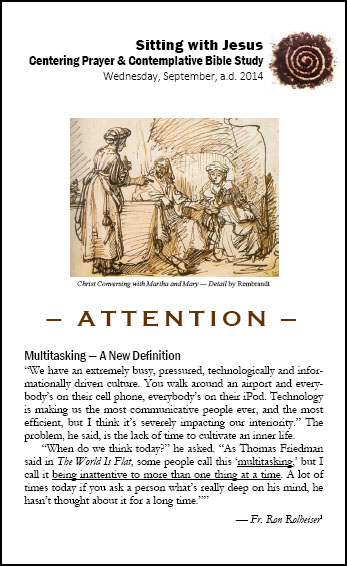
In the Spring and Fall of 2014, I taught a class on Centering Prayer at St. John's Episcopal Church entitled "Sitting with Jesus" which is a reference to the story of Jesus, Mary, and Martha in Luke 10:38-42. We spent more than six weeks learning Centering Prayer, but during the first few weeks I produced a class handout. I am making them available here to be used as is or to be modified to fit anyone's situation.

Session 1 — Intention pdfdoc

Session 2 — Attention • pdfdoc

Session 3 — Thoughts • pdfdoc

Session 4 — More Thoughts • pdfdoc

Session 5 — The Inner Room • pdfdoc

Session 6 — Disciplines of the Beloved • pdfdoc

(They each fit on a single page, 8½ × 11, double-sided, folded in half.)


Sunday, July 12, 2015

A Tale of Two Banquets

Dining with Herod in the Kingdom of Hell 
vs. 
Dining with Jesus in the Kingdom of Heaven
In the Gospel of Mark, the author inserts the flashback-story of John the Baptist's death right before Jesus' feeding of the five thousand. In doing this, Mark sets up a contrast between Herod Antipas and Jesus, between the this worldly-values of Rome as reflected in his macabre birthday banquet and between the values of the Kingdom of God as embodied in the banquet Jesus hosts for five thousand people who are hungry for truth and bread.


RCL • Year B • Proper 10 • Track 2
Amos 7:7–15 • Psalm 85:8–13 • Ephesians 1:3–14 • Mark 6:14–29


John the Prophet
A few weeks ago, on June 24th, we celebrated the Feast of the Nativity of John the Baptist. That is, we celebrated John the Baptist’s birthday. In today’s gospel, we find ourselves at another feast where we witness the circumstances and events that led to John’s death. I call it the Banquet from Hell.

As we all know, John the Baptist was the forerunner of Jesus the Messiah. When the Gospel of Mark opens, when the curtain lifts, John is the first character we see on stage. He is dressed like the prophet Elijah, and he is out in the Judean wilderness announcing the imminent arrival of God’s kingdom. “The Lord is coming soon. Prepare the way of the Lord. Repent, and be baptized for the forgiveness of your sins.” John’s message struck a chord. Crowds of people were heading out into the wilderness to be baptized by John, to make themselves reading for the coming of God’s kingdom. In short, John was leading a spiritual revival, so how does he end up with his head on a dinner platter? Why would anybody kill a baptist, some crazy guy who was out in the middle of nowhere dunking people in a river?

Tuesday, July 07, 2015

The Useless Tree

I have been making my way through Spiritual Formation by Henri Nouwen (with Michael J. Christensen and Rebecca J. Laird. The second chapter is about prayer, and it opens with the following story: 
A carpenter and his apprentice were walking together through a large forest. And when they came across a tall, huge, gnarled, old, beautiful oak tree, the carpenter asked his apprentice: “Do you know why this tree is so tall, so huge, so gnarled, so old and beautiful?”
The apprentice looked at his master and said: “No . . . why?” 
“Well,” the carpenter said, “because it is useless. If it had been useful it would have been cut long ago and made into tables and chairs, but because it is useless it could grow so tall and so beautiful that you can sit in its shade and relax.”
Later on in the chapter Nouwen writes:
The world says, "If you are not making good use of your time, you are useless." Jesus says: "Come spend some useless time with me." If we think about prayer in terms of its usefulness to us—what prayer will do for us, what spiritual benefits we will gain, what insights we will gain, what divine presence we may feel—God cannot easily speak to us. But if we can detach ourselves from the idea of the usefulness of prayer and the results of prayer, we become free to "waste" a precious hour with God in prayer. Gradually, we may find, our "useless" time will transform us, and everything around us will be different.
Prayer is being unbusy with God instead of being busy with other things. Prayer is primarily to do nothing useful or productive in the presence of God. 

From Spiritual Formation: Following the Movements of the Spirit (pages 17, 18). 


Sunday, June 28, 2015

Faith in Jesus (Rather than Faith in Faith)

The question isn’t so much, “How much faith do I have?”
The question is, On whom does my faith rest?”


RCL • Year B • Proper 8 • Track 2

Wisdom of Solomon 1:13-15; 2:23-24
Psalm 30
2 Corinthians 8:7-15
Mark 5:21-43
 

Wednesday, June 24, 2015

The Nativity of St. John the Baptist • June 24th


I like to bring color, beauty, and word together, and so I like to create bulletins for feast days and saint days when we are celebrating them at a special Eucharist.

I am making my files available. Feel free to use them as is or modify them to your own needs.
    • PDF
    • Word


Sunday, June 14, 2015

Frog and Toad and the Kingdom of God

Doing Our Part and Letting God Do God’s Part


RCL • Year B • Proper 6 • Track 2
Ezekiel 17:22-24 • Psalm 92:1-4, 11-14
2 Corinthians 5:6-10, (11-13), 14-17
Mark 4:(21-25)26-34

The Kingdom of God is Like…

Today’s gospel lesson comes from the fourth chapter of Mark. Up to this point in the narrative, Jesus has been announcing the arrival of God’s kingdom, “Repent,” he would say, “for the kingdom of God has come near.” In other words, “Take notice, God’s kingdom is taking over this broken world; and God demands your allegiance. This is good news.” And Jesus demonstrated the presence of God’s kingdom with powerful words and powerful deeds. He preached with an authority that astounded the crowds; he expelled demons with just a word; and he healed the sick with just a touch. People were amazed. But not everyone saw these things as evidence of God’s kingdom at work. As we heard last week, Jesus’ own family thought he was mental unstable and the scribes claimed he was possessed by Satan.

So Jesus began to be more careful; he began to operate more covertly. For example, instead of speaking about God’s kingdom in plain language, he began to cloak the gospel in little stories that we call parables. Jesus hid the kingdom from plain view so that it might have a better chance to get behind people’s natural defenses. In other words, Jesus used parables as a way to smuggled the gospel behind enemy lines. He hid the kingdom, so that the kingdom might be revealed. As he himself said, “There is nothing hidden, except to be disclosed; nor is anything secret, except to come to light” (4:22). He hid the kingdom to reveal the kingdom. This may sound absurd, but this is exactly what every farmer and gardener does. This is what we do. We hide seeds in the earth precisely so that they will come to light. If we didn’t hide seeds in this way, we would never experience harvest.

In today’s gospel, Jesus tells two parables about seeds and sowers to reveal something about the kingdom of God. Note that in both parables, someone plants a seed, and then what happens with the seed is completely out of their control. For example, in the first parable, a farmer plants a seed, and then he goes about his normal life. And despite his lack of attention and effort, the seed grows. 

Frog and Toad, “The Garden”

This reminds me of a story that I read as a kid and that I like to read to my kids now. It is a story about Frog and Toad. Have you ever heard these stories. If you haven’t, Frog and Toad are good friends, very good friends. And if you read their stories, you soon discover that Frog is the sensible one, and Toad, not so much. 

Thursday, June 11, 2015

The Neighbor's Shifty Son... a tale from China

A few years ago I was in my neighborhood library, when I came across Peace Tales: World Folktales to Talk About by Margaret Reed MacDonald. I rechecked it out recently in large part because of the following story about the way in which suspicion can color the way in which we see the world.


The Neighbor’s Shifty Son

A farmer once lost his axe. 

He felt certain that his neighbor had stolen the axe. 
He watched that neighbor with suspicion. 
He noticed that the neighbor’s son seemed as shifty as his father. That boy looked just like a thief. 
The farmer knew he could not trust either of them.


One day when he visited a distant field where he sometimes worked, the farmer discovered his axe. 
He had left it behind the last time he worked the field. 
When the farmer returned home he noticed his neighbor’s son at play. 
The boy looked absolutely normal now.
There seemed nothing shifty or suspicious about him at all.

Tuesday, June 02, 2015

How Can They Give Us Their Blessing, If We Don’t Seek Them Out?

In the late 1990s, the late Henri Nouwen gave a series of sermons at the Crystal Cathedral in Garden Grove, California. The title of the series of talks was, “The Life of the Beloved.” (By the way, they are available on YouTube. Search for “The Life of the Beloved (Henri Nouwen, 2011)”.) Nouwen suggests that the voice of God that addressed Jesus at his baptism, saying, “You are my beloved. I’m very pleased with you,” also addresses us. Unfortunately, we live in a very busy and noisy world. We are so preoccupied that we lose touch with who we are, and the chaos within and without drowns out the voice of God. Spiritual disciplines are designed, in part, to help us tune out the world and tune into what God is speaking to our hearts and minds.

Nouwen says that spiritual disciplines are the human effort to create some open space in our lives so that we can hear the voice of God telling us who we truly are, his beloved, treasured, and valued sons and daughters. Nouwen then speaks of three disciplines that help us create this space for God’s voice in our lives. They are communion, community, and ministry.

In communion, we spend a little bit of our time every day, sitting with God in silence, or spending time with God by prayerfully reading the Scriptures. And in this discipline of communion, we hear the voice of God calling us the beloved.

Then, in community, we are gathered together in worship and in fellowship. In that community of faith, we hear the voice of God speaking to us through one another. And isn’t it amazing how God’s voice becomes amplified when it comes to us as the voice of another human being. One would have thought that it would be enough for us to hear God’s voice directly. But it appears that God has so designed human beings that we need to hear God’s word of love and blessing being spoken by a friend, a family member, or a brother and sister in Christ. “You are God’s beloved.”

Finally, in ministry, the people of God are sent out into the world to proclaim the good news of God’s love. And listen to what Nouwen says about the discipline of ministry:

Jesus went to the poor, the sick, the dying, to the little ones. And dear friends, I cannot tell you enough how the final voice that calls you the beloved comes from those you care for. That’s a great mystery I want to tell you…. [Those whom we serve], they are the ones who God has chosen to speak his word of love to us.
        Do you remember in the Beatitudes, do you remember what it says? “Blessed are the poor. Blessed are the mourning.” It does not say, “Blessed are those who care for the poor.” It does not say, “Blessed are those who console the mourning.” No, no. The blessing is located in the poor. In these people that we want to help, we will find that they carry the blessing in their heart for us, for us to live. They give us life, they give us a sense of God’s presence. And I want to tell you that they whom we go to minister to are the ones who carry in themselves the blessing. And the blessing is the voice of God, saying, “You are my Beloved. On you my favor rests.” We hear that blessing come to us through those who are weak, through those who are poor. And they will lead us closer and closer to the heart of Love.
        That is the great joy I want to announce to you and for you to trust because once you are in deep communion with the poor, you will be able to discover your own poverty, your own weakness, your own brokenness, and not be afraid of it. You will discover, “Yes I am poor too.” When we work with the poor we will become so aware of our own limitations, but the voice of God is saying, “Don’t be afraid because I love you right there where you are poor too.” And so, we become in a way, a fellowship of the weak where the power of God’s grace can manifest itself.
        So keep some space for God’s voice. Some space by praying alone. Some space by forming community. Space by going out and going to those people in your own family, your own friends, and in your own city who need you. They don’t just need you because they are needy, they also need you to give to you their blessing.

So, if there is any truth to this. If the poor have a blessing for us, then how can we find ways—individually and as a community—to enter into relationship with them? Because how can they give us their blessing, which is from God, if we don’t seek them out?

Wednesday, May 27, 2015

The Deeper Meaning of Pentecost

"She Is the Holy Spirit To You"

On Thursday, Rebekah and I celebrated our twenty-first wedding anniversary. As I think back over the past twenty-one years, I can’t help but give thanks for all the blessings that God has given us, not least our four wonderful children. But I am also struck by how much I have grown as a person as a direct result of being married to Rebekah.

I have a friend who is a priest, his name is Fr. Jim Clark. And Fr. Jim once told me how he does marriage counseling. He sits the couple down, and offers two pieces of advice. First, he looks at the woman and says, “You have a project on your hands.” And then he turns to the man and says, “She is the Holy Spirit [to you.]” Now when I first heard this, my egalitarian sensibilities were slightly offended. After all, this didn’t seem to be particularly balanced or mutual. But for the most part, I think this is how our marriage has played out. Let me offer just one example.

When we were first married, Rebekah would come home from school or work and begin telling me about her day. If it hadn’t been a particularly good day, and she was feeling bad, I would listen, and then I would do one of two things. I would either explain why she didn’t need to feel so bad, or I would offer suggestions on how to fix the situation. I thought I was being helpful, but my advice and explanations rarely made her feel better, and in actuality they generally had the opposite effect. Rebekah would complain, “I want you to listen.” And I would say, “I am listening.” But I wasn’t listening, not really. I hadn’t learned to listen or empathize. Instead life had taught me to solve problems and fix things, to such a degree that I really didn’t know the difference between listening and giving advice, the difference between empathizing and fixing.

So early on in our marriage, Rebekah gave me John Gray’s book, Men Are from Mars, Women Are from Venus. I read it. Reluctantly and suspiciously, I read it. And my eyes began to open, ever so slowly. For example, Gray writes:
When a woman is talking about the problems of her day, rather than assuming she is looking for solutions and giving solutions, a man can instead recognize that she is just needing to talk about her day and as a result she will feel better. With this insight, he is free to relax and listen without trying to interrupt with solutions (xxii).
Today, this all sounds like common sense to me, but twenty years ago it was a complete revelation. I found it incredible. How could the simple act of listening help Rebekah feel better? But it did, and it does.

“Mrs. Anderson, I don’t want you to do anything; I just want you to listen.”


Sunday, May 17, 2015

Agents of God's Comfort — Engaging in a Ministry of Presence


Empathy Cards

Last week, I was driving in my car, and I turned on the radio and tuned it to NPR. And I got in on the tail end of an interview with an artist who designs and sells greeting cards online (emilymcdowell.com). Her name is Emily McDowell. Emily was being interviewed because she had just released a new and rather unique line of cards, which she calls Empathy Cards. Not Sympathy Cards, mind you, but Empathy Cards, which have been especially designed for people with a serious illness. Emily herself is a cancer survivor, and she writes:
The most difficult part of my illness wasn’t losing my hair, or being erroneously called “sir” by Starbucks baristas, or sickness from chemo. It was the loneliness and isolation I felt when many of my close friends and family members disappeared because they didn’t know what to say, or said the absolute wrong thing without realizing it.
She continues:
Most of us struggle to find the right words in the face of a friend or loved one’s major health crisis, whether it’s cancer, chronic illness, mental illness, or anything else. It’s a really tough problem; someone we love needs our support more than ever, but we don’t have the right language for it…..
With Empathy Cards, my goal is to help people connect with each other through truth and insight…. I want the recipients of these cards to feel seen, understood, and loved.

Here are a few examples of her cards.  The first one is very simple. The front of the card simply says, “There is no good card for this. I’m so sorry.” 

Another one says, “I’m really sorry I haven’t been in touch. I didn’t know what to say.” And you know that situation. Where you don’t know what to say, and so you don’t say anything. And time passes, and the space becomes awkward, and you don’t know how to break that awkwardness. Well here’s a card for you. It lets them know that you care in an honest way.
Now the next two cards are my favorites because they use humor.


This next one has to be my absolute favorite.


Emily McDowell writes about this card:
Why is it that when you’re sick with a life-threatening disease, so many people feel the need to tell you about someone they know who died of the thing you have? It’s crazy how often this happens. Not only is it unhelpful, it’s actually quite terrifying. Please, everyone, stop doing this.
And so if this happens to be your impulse, buy the card and send it instead.

Thursday, May 14, 2015

The Day of the Ascension • 6th Thursday in Easter


I like to bring color, beauty, and word together, and so I like to create bulletins for feast days and saint days when we are celebrating them at a special Eucharist.

I am making my files available. Feel free to use them as is or modify them to your own needs.

2015 PDF • Word
This year we actually celebrated the Eve of the Ascension

2014 • PDF • Word

Sunday, April 26, 2015

We Have This Treasure in Clay Jars

Bearing Witness to the Lordship of Jesus
with All Faith and Humility


RCL • Year B • Easter 4
Acts 4:1–12 (RCL 4:5–12)
Psalm 23
1 John 3:16–24
John 10:11–18

Watch on YouTube here


“You Are Witnesses of These Things”
If you weren’t here last week, I am sorry to say that you missed out on a wonderful sermon that was delivered by our guest preacher, Don Compier, who is the dean of the Bishop Kemper School for Ministry and who also serves a Spanish-speaking congregation in Kansas City. In his sermon, Don spoke passionately about what it means for us to be witnesses of the Resurrection. Today I want to return to that theme.
     Following his resurrection on Easter morning, Jesus appeared to his disciples for a period of forty days until he was taken up into heaven. One of these appearances occurred on the evening of Easter Sunday. Two of his followers had just returned to Jerusalem, and they were telling the other disciples how they had been encountered by Jesus on the road to Emmaus and how Jesus had made himself known to them in the breaking of the bread. (This recognition scene is the subject of the relief that stands above and behind our altar here at St. John’s.)
     Anyway, while these two disciples are excitedly telling their story, Jesus suddenly appears in their midst. The disciples are all surprised, to say the least. Some are downright terrified because they think they are seeing a ghost. Jesus tries to alleviate their fear by pointing to the holes in his hands and feet. He says, “Touch me and see; for a ghost does not have flesh and bones as you see that I have” (Luke 24:39). And just to make sure that he has left no room left for doubt, the Risen Jesus takes a piece of broiled fish and eats in their presence. 

Sunday, April 05, 2015

Love Bids Us Welcome — Easter Sermon


Good Morning, I Know It's Easter
As many of you know, I was ordained as a deacon back in August of 2013, and then I became a priest in June of last year. Esther, our six-year old, has been very interested in all of this stuff, and she has been very supportive. For example, yesterday, I was sharing with Rebekah some of my plans for today’s sermon. Esther was listening in, and she interrupted our conversation and said, “Daddy, I know how you can begin your sermon.” I was grateful because making a beginning is so often the hardest part. And so, let me begin my sermon today in the words of Esther:
“Good morning, I know it’s Easter.”

I know it’s Easter. But what does it mean to know it’s Easter. At its most basic level, Easter is all about the resurrection of Jesus. Easter is about how God literally raised Jesus from the dead, the same Jesus who, just days earlier, literally died a humiliating and torturous death, with a cry of abandonment on his lips. Why did he die? Why was he raised? These are strange things. So if we want to understand them, if we want to know what they have to do with us in our daily lives, then we need to take a few steps back to gain some perspective. We need to put them into context, because these strange events that have taken place these past three days, are not the whole story, but the climax of a much larger, grander Story.

Friday, April 03, 2015

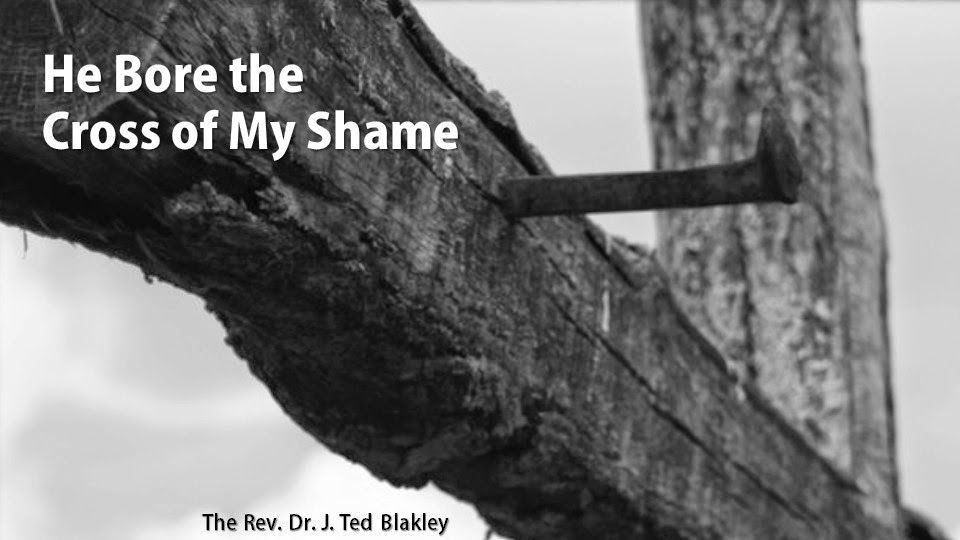
He Bore the Cross of My Shame — Good Friday Sermon


When Adam and Eve ate from the Tree of the Knowledge of Good and Evil, they were overcome by such a deep sense of shame that all they could do was hide themselves from one another and from God. The real tragedy is that they—and all of their unborn children, that is, we—no longer experienced God's presence as a blessing, but as a curse. 
     From that moment, God has worked to restore humanity, to set it free from its original shame and all of the sin, violence, and death that have resulted. This work climaxes on Good Friday where God cures like with like, where God cures our shame by enduring shame.


An audio file can be found here.

Stories of Shame
On Tuesday, I was in Topeka at the annual Chrism Mass, where the priests and deacons and the Bishop gather together to renew our ordination vows. After the service, we had lunch. And I sat down next to one of my colleagues who was talking about his Holy Week sermons. He said, “This year, I am not going to be talking about shame and guilt.” That made may me a bit nervous because that’s all I had been planning to talk about. My friend said he wasn’t going to heap shame and guilt upon his congregation by preaching about how they were the cause of Jesus’ death. Well, I am not planning to do that either. But we’ve got to talk about guilt and shame, for without them we simply can’t make sense of Jesus’ death.

So, tonight, I want to talk about shame. More specifically, I want to talk about “original shame,” which is related to the idea of “original sin,” but which is far more fundamental to our human situation and far more relevant to our daily lives. But I must warn you, tonight’s sermon is only the first part of the story, you will have to come back on Easter Sunday to get the Rest of the Story. Tonight, we will look at three stories of shame.

Story Of Shame #1:  Adam and Eve
The first story of shame is an old story, a very older story. It’s the story of the first man and the first woman, the story of Adam and Eve. You know this story. In the beginning, God plants a garden in Eden, and it needs tending. So God creates Adam from the dust of the ground, and places him in the garden to till it and keep it. Later God creates Eve to be Adam’s partner in this work. They are the perfect couple, ideally suited for one another. And so, life in the Garden of Eden is idyllic. There is plenty of food, there is meaningful work, and “they are naked and not ashamed.”

But turn the page, and things fall apart rather quickly. The crafty serpent convinces our first parents to eat from the one tree in the entire garden that is off limits to them, the Tree of the Knowledge of Good and Evil. And when they partake of the forbidden tree, everything changes. In an instant, their eyes are opened, and they now know that they are naked. Shame washes over them to such a degree that they can no longer bear to be in one another’s presence. They try hiding themselves from one another, but the best they can do is fashion some makeshift clothing out of fig leaves.

That’s what shame does. Shame causes us to hide ourselves from other people, and so cuts us off from one another. And when we are disconnected from others, we are prone to all manner of sin and violence. Even brothers will kill one another when they are disconnected and operating from a place of shame. In short, shame brings about a kind of death, wherein we are separated from ourselves, from others, and especially from God. That’s the next part of the story.


Sunday, February 22, 2015

The Promise of Lent

Lent is a great time to do a bit of spring cleaning,
to declutter out soul by letting go of something
that weighs us down and so clears out some space
to receive the life that comes to us through
Jesus' resurrection at Easter.


RCL • Year B • Lent 1
Genesis 9:8–17
Psalm 25:1–9
1 Peter 3:18–22
Mark 1:9–15

Watch on YouTube here


Into the Wilderness

After Jesus was baptized, “the Spirit immediately drove him out into the wilderness. [And] he was in the wilderness forty days, tempted by Satan.”

A week ago Saturday, we had our first Quiet Day of the year, here at St. John’s. It was designed to help us get ready to enter Lent, which so often sneaks up on us and catches us by surprise, especially this year with Easter coming so early. When we were off on our own, I happened to pick up a book of sermons by Taylor. If you are not familiar with Barbara Brown Taylor, she is an Episcopal priest, a professor of religion, and a writer, who is well known for her sermons. I read a sermon entitled, “Lenten Discipline,” (from Home by Another Way) which offers some insights into the purpose and promise of this season we call Lent. I found it very helpful, so I would like to share it with you today. What follows, then, is Taylor’s sermon with a few modifications and additions. She begins:  (Taylor's words are in blue). 

Sunday, February 08, 2015

When Things Fall Apart: Exchanging Fear for the Wings of an Eagle


RCL, Year B, Epiphany 5
Isaiah 40:(18-20)2131
Psalm 147:1-12, 21c
1 Corinthians 9:16–23
Mark 1:29–39

Video on YouTube
I'm a little off center in this one.


Delivered on Sunday, February 8th, a.d. 2015
at St. John's Episcopal Church (Wichita, Kansas)

Sunday, February 01, 2015

Holy Is As Holy Does


RCL, Year B, Epiphany 4
Deuteronomy 18:15–20
Psalm 111
1 Corinthians 8:1–13
Mark 1:21–28

Download PDF
Watch on YouTube

HOLY IS ALL AROUND US

Today, I want to offer a brief meditation on the word, holy, which is one of the church’s most important four-letter words. Why? Because “holy” is everywhere today. For example, following the sermon, Armani and Aaliyah are going to undergo the sacrament of Holy Baptism. During that liturgy, we who have been baptized will renew own baptismal covenant, by confessing our belief in the Holy Spirit and in the holy catholic Church. Afterwards, we will all gather at the Lord’s table and celebrate Holy Eucharist, or Holy Communion. And just a few minutes ago, we heard the Holy Gospel, in which an unclean spirit cries out, Jesus of Nazareth, “I know who you are, the Holy One of God” (Mark 1:24). So holy is all around us today.

HOLY AS BEING SET APART FOR A SPECIAL PURPOSE

But what exactly does it mean? When we describe something as holy, what is it that we are trying to say about it? Holy has a variety of meanings. For example, holy may be used to characterize an object or a person’s state of being. In this usage, to be holy is to be pure, unblemished, without fault or defect, and to be unholy is be defective, impure, or unclean. 
     But the word holy can also be used to describe something that has been set apart, something or someone that has set apart for a special use, purpose, or calling. In this usage, the opposite of holy would be common or ordinary. So, if you wanted to, you could describe your fine china as holy because it is only brought out on special occasions and used for special purposes. Such holy china stands in contrast to the ordinary plates, cups, and silverware that you use for every day purpose.
So when we describe the Eucharist as Holy, we are saying that this meal has been set aside for a special purpose. The Holy Eucharist is a meal, but it is a meal like no other. Likewise, Holy Baptism is a bath, but it is not like any other bath or shower you will ever take. It has been set apart for a special purpose. And the Holy Catholic Church—of which we are all a part—is a community like no other. It too has been called and set apart for a special purpose.

HOLY IS AS HOLY DOES

But holy goes even further than this. If something is holy, then it has an effect. Do you remember the movie Forrest Gump? Forrest Gump was the main character, and he had some mental deficiencies, and so he was often made fun of. But do you remember what his mother taught him to say when kids called him stupid? “Stupid is as stupid does.” Well, I think the same thing can be said of the word holy. “Holy is as holy does.”
     You see, if something is holy, it doesn’t just sit around being holy, it accomplishes something; it has an effect on its environment. In other words, holy doesn’t simply describe what a thing is in itself, it describes what something does. Holy is as holy does.
Let me offer an example of this. Three weeks ago, we heard read the story of John the Baptist baptizing people in the Jordan River. He told them, “[There is a one more powerful than I am who is coming.]… I have baptized you with water, but he will baptize you with the Holy Spirit” (1:8). Now, there are two observations that need to be made [or, that I would like to make.]

Why the Spirit is Called Holy in Mark's Gospel

First of all, in Mark’s Gospel, God’s Spirit is called the Holy Spirit, in large part, because there is more than one type of spirit operating in the world. For example, you may have noticed in today’s reading that the troubled man in the Capernaum synagogue was not described as having a demon. Rather he was described as having an unclean spirit. Now, it should be said that demon and unclean spirit refer to the exact same thing, but in his gospel, Mark exhibits a decided preference for the term, unclean spirit. Why? Because he wants to emphasize what these spirits do; he wants to highlight the effect that these spirits have. These spirits communicate uncleanness to their victims. These spirits can take over a person and defile them and their surroundings.
     In sharp contrast to these unclean spirits stands the Holy Spirit. Holy is not the Spirit’s first name. The Spirit of God is called holy because the Spirit cleanses an unclean world. Unclean spirits defile the world by communicating impurity, sin, and sickness, whereas the holy Spirit cleanses the world and its people by communicating purity, holiness, and wholeness. The opening chapters of Mark can be read as a tale of two spirits—the holy Spirit of God verses the unclean spirits of Satan.

What it means that Jesus will baptize with the Holy Spirit

This leads to my second observation. When John says that Jesus will baptize with the Holy Spirit, he is not referring to the Day of Pentecost, the day when the Holy Spirit will come upon all of Jesus’ disciples. Instead, John is describing Jesus’ entire ministry. In other words, every single thing that Jesus does in Mark’s gospel can be characterized as baptizing with the Holy Spirit. Because everything that Jesus does has a cleansing, restorative effect. His exorcisms and healings, his pronouncements of forgiveness, his table-fellowship with tax-collectors and sinners, all of these things create holiness and wholeness, where once there had only been sin and brokenness. Holy is as holy does.
     We saw the cleansing power of the Spirit at work in today’s gospel. As was his custom, Jesus is in the synagogue on the Sabbath. It’s a holy place on a holy day, and in walks an unholy man, unholy because he is under the influence of an unclean, dehumanizing power over which he has no control. This poor man can no longer help himself. He has no power to act on his own, he has no power to speak. He has lost all self-determination and self-control, he has lost his own voice. I wonder if you have ever experienced this?
     And so Jesus baptizes him, Jesus bathes this unclean man with the cleansing power of the Holy Spirit. Jesus commands the unclean spirit, and the man is set free. He has been made clean, his life has been restored, and he has been restored to the community of faith. He was dead, and now he is alive. That is holy, and that is what we do today.

CONCLUSION (just notes)

Holy Baptism, Holy Eucharist, Holy Church, and we have become Holy.
The Holy Spirit animates all of these, so that they have an effect (including us).


The conclusion of the sermon can be found on the video.

Delivered on Sunday, February 1st, a.d. 2015
at St. John's Episcopal Church (Wichita, Kansas)

Sunday, November 23, 2014

Kindness in the Name of the King


RCL, Year A, Proper 29.1

Ezekiel 34:11-16, 20-24
Psalm 100
Ephesians 1:15-23
Matthew 25:31-46

Watch on YouTube


CHRIST THE KING SUNDAY

Good Morning. It’s good to see all of you. Today is a very special day. For the past 5½ months we have been in the Season after Pentecost. And each week we would begin our service with, “Welcome to St. John’s on this, the 7th Sunday after Pente-cost.” Or “Welcome on this, the 15th Sunday after Pentecost,” Or last week’s, “Welcome on this the 23rd Sunday after Pentecost.” Well, it has finally arrived, to-day is the Last Sunday after Pentecost, the last Sunday of the Church year. This means that next Sunday is the start of a brand new year, the beginning of Advent, when we prepare ourselves for the coming of Christ, his second coming and his first coming, in that order.

But today is the Last Sunday of the Church Year. And it is on this day that we celebrate the Feast of Christ the King, which is why we are wearing our celebratory white vestments. The official name of this feast day is the Feast of Our Lord Jesus Christ the King. It may surprise you to know that this is a fairly new feast as Church feasts go. It did not originate in the Middle Ages, nor did it originate in the 15th or 16th centuries. Instead, it was instituted in 1925 by Pope Pious XI in an at-tempt to thwart the expansion of secularism, which Pope Pious attributed to the fact that the world was increasingly denying the lordship and authority of Jesus Christ. In his encyclical Quas Primas, Pope Pious writes, the 
manifold evils in the world [are] due to the fact that the majority of men [have] thrust Jesus Christ and his holy law out of their lives; that these [have] no place either in private affairs or in politics: and… as long as individuals and states [refuse] to submit to the rule of our Sav-ior, there [will] be no really hopeful prospect of a lasting peace among nations.
In other words, there can be no genuine peace in a world that continues to live as though its Lord and Savior did not exist or have authority. And so, on this day, we remember, we celebrate, and we proclaim the fact that Jesus Christ is King,… not just our King, but the King,… the Lord of all creation, the Lord of everything that exists. 

And so today, all of our readings point to the fact that God has made Jesus of Nazareth “King of kings and Lord of lords” (REV 19:16), by giving him “all authority in heaven and on earth (MATT 28:19).”  So in Ezekiel, the prophet anticipates the day when God will rescue his people and set over them a shepherd, the Son of David, who will feed them with justice. Then, in Ephesians, Paul writes of the power that God has made available through Christ, who sits at God’s “right hand in the heav-enly places, far above all rule and authority and power and dominion, and above every name that is named, not only in this age but also in the age to come” (EPH 1:20–21 ).

In all of these passages, I hope you are getting a glimpse of the picture being presented, namely, that Jesus’ authority encompasses all spheres of existence. His authority is not just heavenly, but earthly as well. He is not only Lord over the church, but Lord over society and the state. His authority is not just moral, reli-gious, or spiritual, it is also political, economic, and social. He is Lord in private matters, and king in public matters. Consequently, all human beings owe their alle-giance to Jesus. 

WHEN THE SON OF MAN COMES IN HIS GLORY…

The comprehensive nature of Jesus’ authority is also highlighted in today’s gospel reading. This passage is often called the Parable of the Sheep and Goats, but it’s not actually a parable. Instead, it is an account of the final judgment, the only such account in all of Scripture. It’s a remarkable scene. Jesus returns at the end of the age in all his kingly glory. He sits on his throne, and all the nations of the world are gathered before him. And he begins to separate the people, making distinctions between the sheep and the goats. King Jesus bases his judgments on whether a person served and cared for him when he was in need. But both the sheep and the goats are confused, for neither group ever remembers seeing Jesus hungry or thirsty, lonely, naked, sick, or in prison. But Jesus responds, “Truly I tell you, just as you did it to one of the least of these who are members of my family, you did it to me” (25:40).

“THE LEAST OF THESE” — THE UNIVERSALIST INTERPRETATION

Now, there’s a question we must ask. Who are “the least of these” of which Jesus speaks, “the least of these” whom Jesus describes as his own brothers and sisters. One interpretation is that “the least of these” refers to the poor, the down-trodden, and the oppressed of humanity in general. If so, then Jesus is showing us that salvation consists in seeing and serving Jesus in everyone we meet, especially the poor, the homeless, the imprisoned. This is a common interpretation, and one that finds support in Matthew’s gospel, but there is another interpretation that also finds support.

“THE LEAST OF THESE” — THE PARTICULARIST INTERPRETATION

Elsewhere in Matthew, when Jesus makes reference to the least or to the little ones, it is always in reference to his disciples. Likewise in Matthew, when Jesus re-fers to “his brothers and sisters,” he is not referring to human beings in general, but to his disciples in particular. And so, when Jesus is separating the sheep and the goats in the final judgment, his judgments are based upon how the nations of the world treated his followers. 

You see, before today’s passage, Jesus had told his disciples that, when he was gone, they would be sent as his emissaries to proclaim the gospel to all the nations (24:14). However, the world they would be witnessing to would be hostile. Jesus said, “they will hand you over to be tortured and will put you to death, and you will be hated by all nations because of my name” (24:9). In other words, as the disci-ples carried out their vocation as evangelists and missionaries to the nations, they would experience hunger, thirst, loneliness, nakedness, sickness, and imprisonment. Yet, those who welcomed Jesus’ disciples, and extended hospitality to them, they would be numbered among the sheep. They would be acknowledged as belonging to God’s flock. They would receive the same reward that the followers of Jesus had received, eternal life. 

All of this fits with what Jesus told his disciples earlier in the gospel when he sent them on their first missionary tour: 
See, I am sending you out like sheep into the midst of wolves; so be wise as serpents and innocent as doves. Beware of them, for they will hand you over to councils and flog you in their synagogues; and you will be dragged before governors and kings because of me, as a testi-mony to them and the [nations]…. and you will be hated by all be-cause of my name….
[But] Whoever welcomes you welcomes me, and whoever welcomes me welcomes the one who sent me. Whoever welcomes a prophet in the name of a prophet will receive a prophet’s reward; and whoever welcomes a righteous person in the name of a righteous person will receive the reward of the righteous; and whoever gives even a cup of cold water to one of these little ones in the name of a disciple—truly I tell you, none of these will lose their reward (MATT 10:40–42).
And so, at the end of history, when Jesus returns and the peoples of the world are gathered before their king, they will be judged by how they have treated Jesus’ followers. 

Why is this? Because when Jesus left, he put his followers in charge of the king-dom. In his first coming, Jesus established the kingdom of God through his life, death, resurrection, and ascension. But then Jesus went away, and he entrusted the kingdom and its expansion to his followers. That’s what he had been training them for.

OUR TALENT OF RESPONSIBILITY…

This is all reminiscent of last week’s Parable of the Talents. Do you remember the story? A man goes on a journey, but before he leaves, he calls his slaves together and entrusts his property to them. He does not give them all the same responsibil-ity. To one he entrusts five talents, to another two talents, and to another just one talent. In short, each slave is given a level of responsibility that matches their gifts and abilities. Then, when the master returns, he settles accounts with his slaves, he finds out what they have done with what they were given. 

This parable is about Jesus leaving his followers in charge of the kingdom. Jesus has gone away, and he has entrusted the gospel to us. We have been recruited, and we have been commissioned. We have been called and equipped to take the gospel into all the world. And the world is wherever we are. The world might be on some distant, foreign shore. Yet, more often than not, the world is to be found in our normal, everyday lives. The world is in our own neighborhoods, in our own fami-lies, at our places of work. Those are the places we have been called to proclaim the gospel by word and by deed, with our words and our actions. 

And how we go about doing this matters, because according to today’s gospel reading, the peoples of the world will be judged on the basis of how they respond to the followers of Jesus,… to us. Honestly, I am not sure how much I like that idea. That seems like too much responsibility. I would prefer to believe that there is no final judgment. I would prefer to believe that in the end everybody gets saved and that it has nothing to do with me. I just want to live a normal life, free of such concerns… to bury my talent in the ground and hand it back to Jesus when he re-turns. 
But alas, Jesus doesn’t allow us that luxury. It’s not an option. Why? Because he loves the world too much. People are broken, and they need to know how much God loves them. People are enslaved to forces beyond their control, and they need to be set free. People are in need of a loving Lord and Savior, and so they need someone to show them Jesus. Not simply so that they will go to heaven someday, but so that they can experience the eternal kind of life in the here and now.

CONSPIRACY OF KINDNESS

We are called to know Christ and make Christ known. But where do we begin? In my studies at Kansas School for Ministry, we read a book called, The Conspiracy of Kindness. In this book, the author, Steve Sjogren, describes what he calls kindness evangelism, which he defines as “demonstrating God’s love… by offering to do some humble act of service… in Christ’s name… with no strings attached.”

Let me give you some examples of these humble acts of service in Christ’s name:
  • Buying newspapers and giving them away on a busy street corner.
  • Handing out free water at a 5K run.
  • Wrapping Christmas presents for free at a store
  • Going door to door and offering to do yard work for free
  • Conducting Free car wash where no donations are accepted 
  • Going to stores in a mall and offering to clean their toilets for free
And when people ask (and they will ask), who are you and why are you doing this, the typical response goes something like this, “We are just trying to show God’s love in a practical way.” This is important. This is what distinguishes kindness evangelism from random acts of kindness. Our humble acts of service are in the name of Jesus, and it is important that this is made known. For if we don't follow our actions with words, the people we are seeking to serve “will only know that we are nice people, not that God loves them.” 

On the video I have include some stories of the powerful effects
these humble acts of service in Jesus’ name have had.

Perhaps this is the place to begin. And perhaps there is no better way to honor Jesus as Lord of lords and King of kings, than to engage in such humble acts of kindness which are so reflective of the life that he himself led.

In the name of the Father and the Son and the Holy Spirit. Amen.

Delivered on Sunday, November 23rd, a.d. 2014
at St. John's Episcopal Church (Wichita, Kansas)